
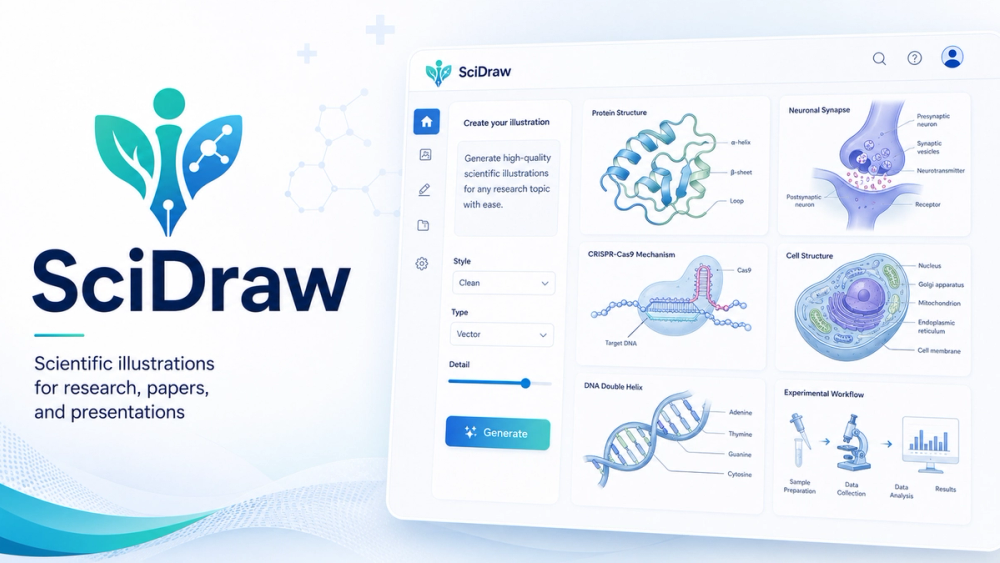
SciDraw is an AI-powered platform designed to transform complex scientific concepts into clear, labeled diagrams, figures, and schematics. It caters specifically to researchers, educators, and technical communicators who need to visualize scientific information accurately and efficiently.
The platform offers a comprehensive suite of tools to streamline the scientific illustration workflow:
- Scientific Figure Generator: Creates manuscript-style scientific figures, mechanism layouts, and research visuals from structured prompts.
- Sketch to Scientific Figure: Converts rough sketches, whiteboard notes, and hand-drawn layouts into polished scientific figure drafts.
- Graphical Abstract Generator: Produces compact graphical abstracts that effectively explain a study's question, method, mechanism, and outcome.
- Reference to Scientific Figure: Allows users to start with an existing reference image, paper figure, or screenshot to generate a new scientific diagram.
- Paper to Scientific Figure: Transforms sections of research papers, methods notes, or abstracts into clear scientific figure concepts and workflows.
- Scientific Figure Enhancer: Improves existing scientific figures by providing cleaner labels, simplified layouts, and clearer visual hierarchy.
- Mechanism Diagram Generator: Specializes in creating mechanism diagrams for chemical reactions, biological processes, and engineering systems.
- Text to Scientific Figure: Generates labeled scientific diagrams, schematics, or research visuals from plain-English descriptions.
- Experimental Setup Diagram Generator: Creates annotated apparatus diagrams for lab methods, optics paths, reactors, sensors, and measurement systems.
SciDraw's workflow is straightforward:
- Describe or upload the source: Users can write a prompt, upload a sketch or reference, or paste paper notes, specifying labels, diagram type, and output constraints.
- Generate a scientific figure draft: The AI drafts various scientific visuals, including mechanisms, graphical abstracts, schematics, and setup diagrams, based on the provided structure.
- Review, refine, and export: Users can then check labels, arrows, scientific claims, and alignment before exporting the high-resolution output in formats like 4K Ultra HD and SVG vector for use in slides, manuscripts, or teaching materials.
Unlike generic AI image tools, SciDraw is built for scientific accuracy and clarity. It ensures scientific structure, readable and accurate text annotations, and publication-ready layouts. It supports guided sources (text, sketches, references, papers) rather than relying solely on prompt-only guesswork. The tool is designed to produce review-ready drafts for refinement, covering a broad range of research fields including biology, chemistry, physics, and engineering. This focus on scientific integrity makes SciDraw an invaluable asset for academic and technical communication, significantly reducing the time and effort required to produce high-quality scientific illustrations.