Overview
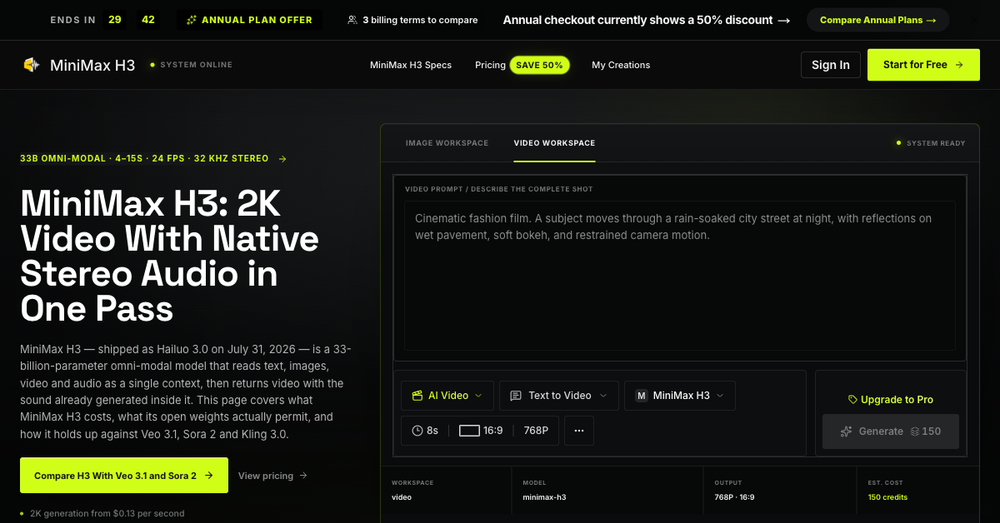
MiniMax H3 is an AI video generation workspace built around the MiniMax H3 model, shipped as Hailuo 3.0 on July 31, 2026. MiniMax H3 is a 33-billion-parameter dense omni-modal transformer that treats text, images, video and audio as one stream rather than routing each modality through a separate pipeline, and it returns video with the sound already generated inside it. Counting encoders and VAEs, the full MiniMax H3 inference stack sits closer to 69 billion parameters.
Key Features
- Native 32 kHz stereo audio: the H3-Omni Transformer produces voice, effects and ambience inside the same pass as the picture. This is the capability that most clearly separates MiniMax H3 from Sora 2 and Kling 3.0, both of which need a separate audio stage.
- 2K by regeneration, not upscaling: the base model renders at 768 pixels on the short edge, then regenerates that output in-context to reach 2K. Hosted calls can request 2K directly, which is why fine detail survives instead of being interpolated.
- 4 to 15 seconds at 24 FPS: durations run in whole seconds at a fixed frame rate, and native multi-shot modelling means a single MiniMax H3 clip can contain more than one camera setup.
- Six documented aspect ratios: 21:9, 16:9, 4:3, 1:1, 3:4 and 9:16, with adaptive framing available in image-conditioned flows.
- Multimodal reference briefs: reference input accepts up to nine images, three video clips and three audio files, capped at twelve files combined, so identity and behavior can be carried by evidence a text prompt cannot express.
- 24 reproducible prompt recipes: every published video example ships with the complete prompt behind it, covering cinematic reveals, character action, vertical short drama, product launches, anime transitions and dialogue replacement.
- Documented model comparisons: MiniMax H3 is measured head-to-head against Veo 3.1, Sora 2 and Kling 3.0 on maximum resolution, clip length, native audio support and published per-second cost.
Use Cases
Performance marketing teams produce 2K social cuts with sound in a single generation pass, where the same budget previously covered fewer 1080p variants. Short-drama and vertical video creators get dialogue, room tone and effects without scheduling a second audio run. Production studios use the comparison tables and specification pages to decide between MiniMax H3, Veo 3.1, Sora 2 and Kling 3.0 before committing spend on a campaign. ML infrastructure engineers check the 42.5 GB minimum working set and the reported 12 GB VRAM floor before attempting a local deployment. Product and legal teams verify commercial-use terms, attribution placement and regional availability before shipping MiniMax H3 output to customers.
Getting Started
A reliable MiniMax H3 evaluation starts by writing acceptance criteria — subject traits, required action, one camera behavior, the audible event and the failure conditions — before touching an endpoint. From there the workspace exposes text-to-video, image-to-video and multimodal reference routes, and the documentation explains when to pick a text-plus-anchor brief over a mixed-evidence reference set. Naming one sound and one camera move in the prompt creates a testable relationship between audio and image, and recording which resolution path produced a clip keeps local 768p output from being compared against hosted 2K.
Pricing & Plans
MiniMax H3 is freemium. Recurring plans start at $9.9 per month with 9,600 credits on annual billing, a Pro tier at $19.9 per month with 24,000 credits, and a Studio tier at $44.9 per month with 72,000 credits. Hosted model generation is documented at $0.13 per second of 2K output and $0.08 at 768p, putting a maximum-length 15-second 2K clip near $1.95.