
Overview
Papaya is the optimization engine for AI agents. It helps engineering teams continuously improve agents that have already shipped to production. The product is designed for the work that begins after an agent is live: understanding real production runs, finding improvements that are easy to miss, ranking those improvements by likely impact, and turning approved fixes into pull requests that engineers can review and ship.
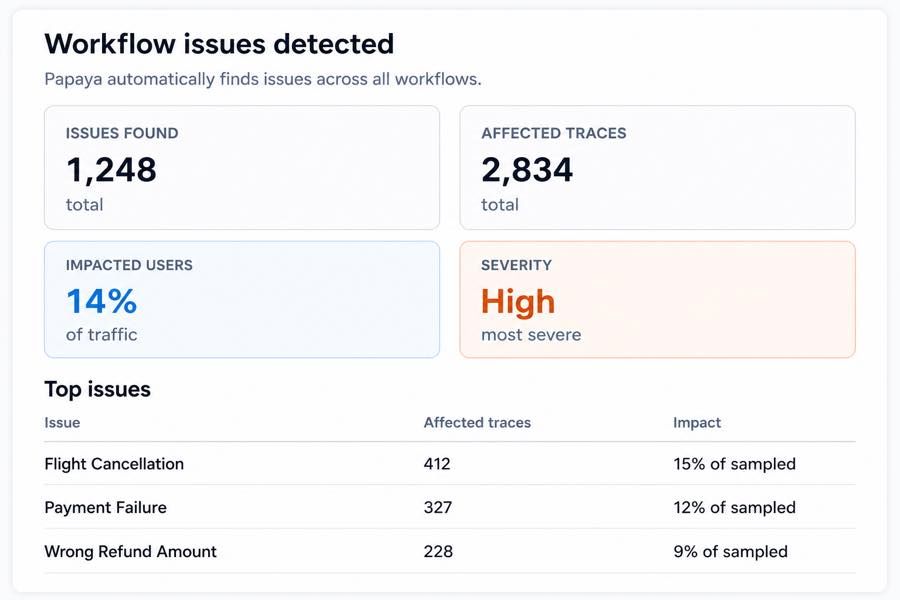
Teams building agents often have plenty of traces but not enough time to read them. Context bloat, overly chatty subagents, serial API calls, uncached embeddings, oversized prompts, broken tool calls, quality regressions, unnecessary latency, and avoidable model cost can remain hidden in production data. Papaya connects directly to an agent through its SDK and analyzes those runs so recommendations are grounded in production behavior.
How it works
Once the SDK is connected, Papaya normalizes production traces and analyzes prompts, context, model calls, subagents, tools, and related agent components. It runs more than 200 research-backed analyses across context, prompts, prompt caching, subagents, and tool calls.
Papaya presents actionable recommendations ranked by impact on quality, latency, and cost. Engineers can inspect the production runs that produced each finding, understand why it matters, and decide whether the proposed change belongs in their system. When a recommendation is approved, Papaya opens a pull request. The team can then review the code change, run its own checks, and merge it through the same process used for other production changes.
What Papaya analyzes
Context analysis identifies unnecessary or duplicated information that consumes tokens without improving the result. Prompt analysis surfaces opportunities to make instructions clearer, smaller, or more consistent. Prompt-caching analysis identifies repeated work that may be reused. Subagent analysis can expose excessive coordination or overly chatty behavior. Tool-call analysis finds broken, inefficient, or unnecessarily serial interactions with APIs and external systems.
These areas are connected. A large prompt can increase latency and cost. Repeated context can make a model less focused. A serial tool pattern can slow an entire workflow. Papaya evaluates these behaviors together so teams can focus on changes with the strongest expected impact.
Evidence-first recommendations
Recommendations include the runs that produced them instead of asking engineers to accept generic advice. This makes it easier to understand whether an issue is frequent, which workflows are affected, and what the proposed change should improve. Papaya reports that a first workflow analysis typically identifies improvements capable of delivering a quality gain of more than 10 percent, while keeping the underlying evidence attached to every recommendation.
Who it is for
Papaya is for engineers and teams operating AI agents in production. It supports teams responsible for agent quality, reliability, performance, and model spend, as well as founders and product engineers who need to improve an agent without creating a separate manual optimization process.
Papaya launched on September 1, 2026. It is built by Nile AI Inc., a three-person Y Combinator Fall 2026 company based in San Francisco. It offers a free Developer plan, a $500-per-month Business plan, and custom Enterprise pricing. Learn more at https://papaya.fyi/.