
Editorial note: SaaSFame reviewed TheAudioStuff's public website, tools, methodology pages, and current catalogue. TheAudioStuff did not control this article. Dynamic counts and listed prices were checked on September 2, 2026.
Quick verdict
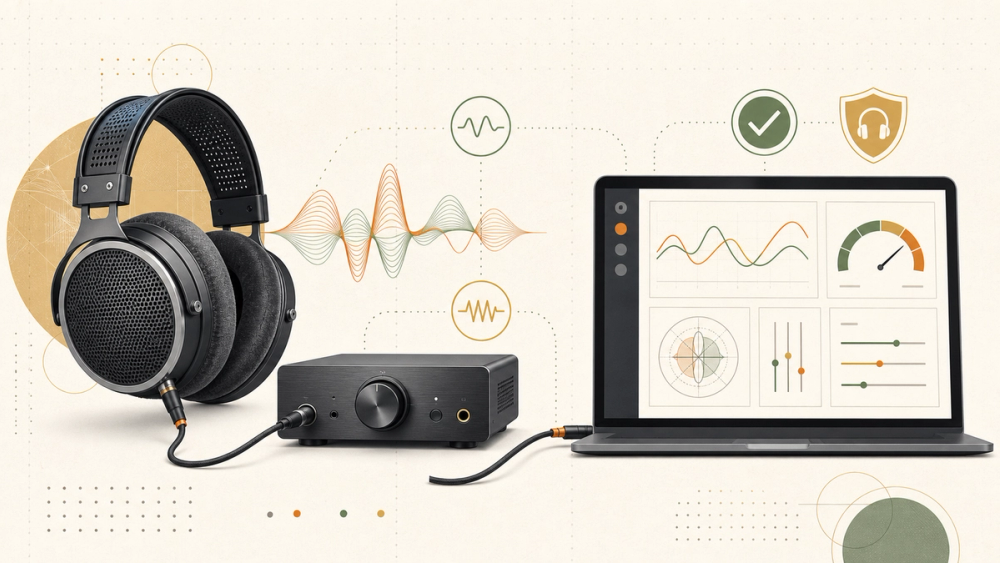
TheAudioStuff is an unusually useful hybrid: part independent hi-fi publication, part browser-based audio toolkit. Its biggest advantage is not that it tells everyone to buy the same “best” product. It gives readers enough structure to check whether a purchase makes sense for their headphones, amplifier, room, files, and listening habits.
The platform currently lists 16 free browser tools, 68 reviews across seven gear categories, 37 head-to-head comparisons, and 11 buying guides. Those numbers come from TheAudioStuff's own live pages and will change as the catalogue grows.
SaaSFame rating: 9.2/10. The combination of practical calculators, local file processing, published review standards, and direct comparisons is excellent. The main trade-off is breadth: 68 reviews is a carefully organized catalogue, not an exhaustive database, and its wireless/ANC coverage remains much smaller than its wired audiophile coverage.
Best for: headphone enthusiasts, hi-fi buyers, vinyl listeners, and home-studio users who want to validate a setup before spending money.
Less suitable for: shoppers who need the broadest possible catalogue of mainstream wireless headphones, televisions, soundbars, or other consumer-electronics categories.
What is TheAudioStuff?
TheAudioStuff is an audio review and decision-support website founded by Jakub Charkiewicz in May 2023. Reviewer Bastien Beauchamp joined in April 2026. Its editorial scope includes headphones, speakers, DACs, headphone amplifiers, speaker amplification, sources, and accessories.
The site has three connected layers:
- Reviews and buying guides use a shared 0-to-10 scoring system anchored to a published reference list.
- Head-to-head comparisons place closely related products on the same scale and explain the score gap.
- Free browser tools cover power matching, room acoustics, blind listening, hearing safety, equalization, cable calculations, and file analysis.
This integration is the important part. A conventional review might say that a headphone is hard to drive. TheAudioStuff also gives you a calculator that turns impedance, sensitivity, listening level, and crest factor into an estimated power and voltage requirement.
Why audio-gear mismatches become expensive
Audio specifications are easy to misread. Headphone sensitivity may be quoted in dB/mW or dB/V. A high-impedance dynamic headphone can require more voltage, while a low-sensitivity planar can require substantial power and current. Speaker-wire loss depends on the cable length, conductor, and speaker load—not simply the price printed on the box.
Room behavior complicates the decision further. Below the room's transition region, dimensions and listening position can produce strong peaks and nulls. A larger speaker or more powerful amplifier does not automatically solve that acoustic problem.
TheAudioStuff cannot guarantee compatibility, because its output still depends on the accuracy of the specifications and assumptions entered by the user. What it can do is expose the variables that sales pages often leave disconnected. That makes an avoidable mismatch easier to catch before checkout.
The standout tool: Headphone Power Calculator
The Headphone Power Calculator is the best demonstration of the platform's approach. It accepts sensitivity in either dB SPL/mW or dB SPL/V, impedance, an average listening target, and a crest-factor assumption based on the type of material being played. You can also enter the maximum RMS output of a source to estimate the remaining headroom.
The distinction between average level and musical peaks matters. The tool's published formula adds the selected crest factor to the target listening level. To model a 110 dB peak for music with an 18 dB crest factor, for example, the average target should be 92 dB—not 110 dB with another 18 dB added on top.
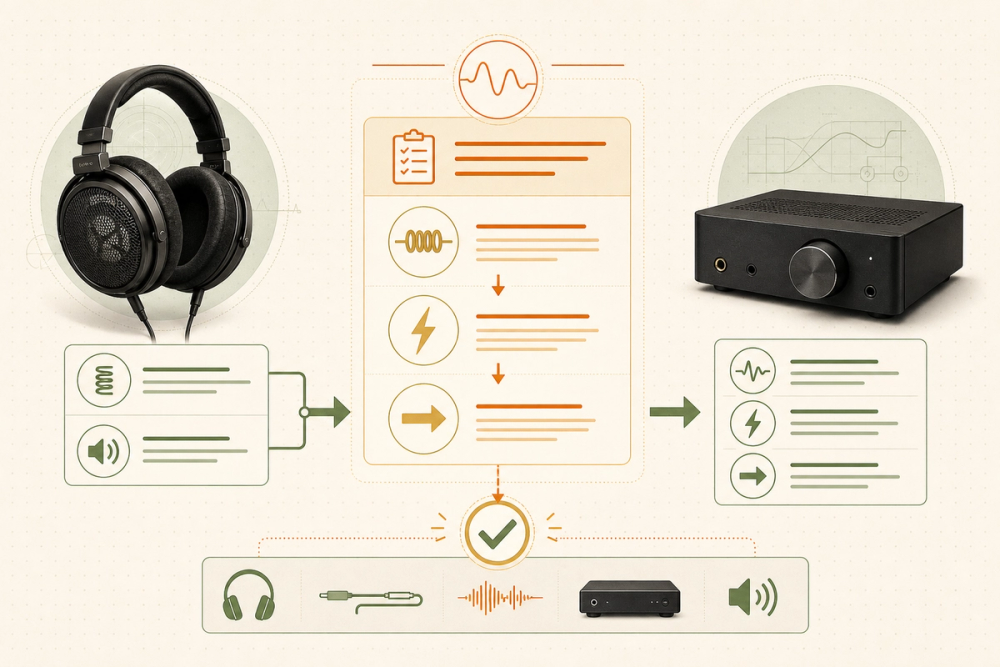
The result translates the inputs into required power, RMS voltage, and peak-voltage swing. Those figures can then be checked against an amplifier's output specification at a relevant load. It remains an estimate rather than a warranty, but it is much more informative than comparing a single “watts at 32 ohms” headline across every headphone.
A corrected real-world example
The HIFIMAN Arya Organic is listed by both TheAudioStuff and HIFIMAN at 16 ohms and 94 dB/mW. Using TheAudioStuff's published equation, a 92 dB average target plus an 18 dB crest factor produces a 110 dB peak requirement of approximately:
- 39.8 mW of power
- 0.80 Vrms
- 1.13 V peak
- roughly 70.5 mA peak, derived from peak voltage divided by impedance
These values explain why the assumptions must be stated. Entering 110 dB as the average level and then adding an 18 dB crest factor would produce a dramatically larger and less realistic requirement for this scenario.
Room and treatment tools
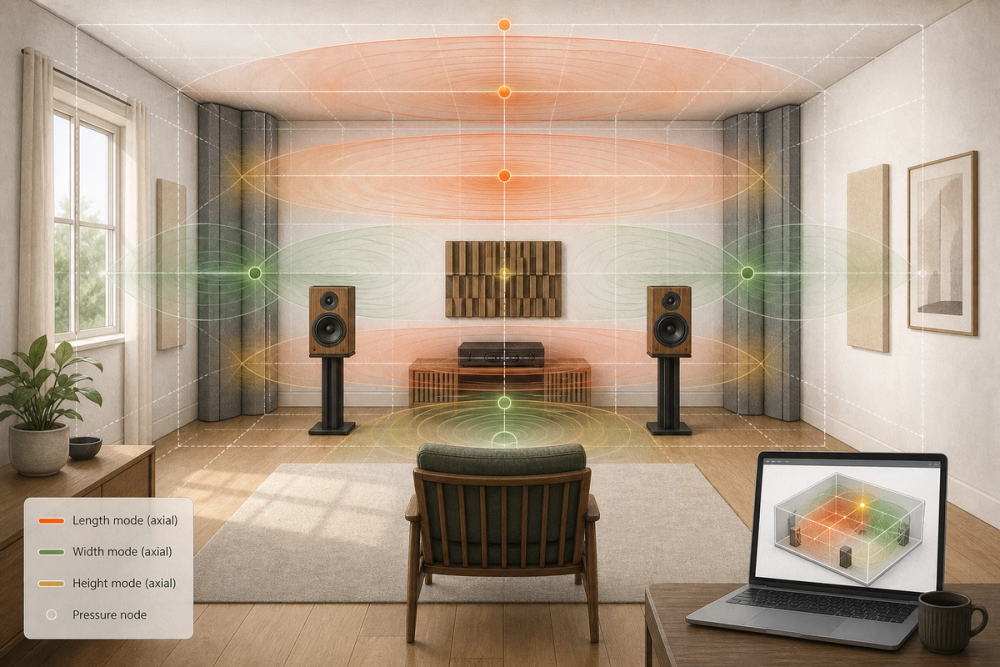
The Room Mode Calculator models a rectangular room from its length, width, and height. It calculates axial, tangential, and oblique modes below 300 Hz, maps pressure behavior, and flags closely spaced modes that may create audible bass problems.
That is valuable for exploring candidate listening positions and treatment priorities, but it is a theoretical model. It does not import a calibrated microphone sweep, and it does not model L-shaped rooms or arched ceilings. Real rooms still need measurement when accuracy matters.
The companion Acoustic Panel Calculator estimates porous-absorber performance from 20 Hz to 8 kHz. Users can vary panel thickness, material flow resistivity, incidence model, and the air gap behind the panel. It calculates NRC and SAA and includes presets such as Owens Corning 703, Rockwool, and GIK products.
That makes the tool useful for comparing treatment ideas before construction. Its own guidance also makes an important point: a single NRC value says little about deep-bass performance, so the full absorption curve matters.
Tools for testing claims with your own ears and files
The rest of the suite is not filler. Several tools address recurring audiophile questions in a practical way.
ABX Blind Test
The ABX Blind Test lets a listener compare A and B against a randomized X. It supports built-in samples or the user's own files, keeps playback position aligned while switching, applies RMS level matching, and calculates a binomial p-value.
A result below p < 0.05 means the score would be unlikely under random guessing. A null result is narrower: it means the listener did not demonstrate a difference with that material and setup. It does not prove that two sources are identical.
Hi-Res Audio Checker
The Hi-Res Audio Checker performs FFT analysis locally and displays the spectrum of an audio file. An abrupt cutoff around 20–22 kHz can be evidence that a file originated from a lower-sample-rate source before being upsampled.
The visualization is a diagnostic clue, not conclusive proof of fraud or audibility. Some genuine recordings roll off early because of microphones, filters, or production choices. The useful part is that the file remains on the device while the user investigates its spectral content.
Online Graphic Equalizer and ear training
The Online Graphic Equalizer provides ten bands with real-time listening and exports for Equalizer APO, AutoEQ, Wavelet, and Poweramp. The EQ Ear Training Game, Sound Signature Quiz, and Safe Headphone Volume Calculator extend the platform from buying decisions into listening education.
Across the suite, TheAudioStuff states that audio files are processed in the browser and are not uploaded. The tools require no account, download, or payment.
Cable calculators: useful because the inputs are explicit
The Speaker Wire Gauge Calculator evaluates resistance and loss for the actual run length, speaker impedance, conductor, and gauge. Its current practical guidance is that 16 AWG copper is adequate for many normal home runs, with thicker cable becoming useful for longer distances or lower-impedance speakers.
That is a more defensible conclusion than claiming that one gauge is always sufficient or that price alone determines performance.
For vinyl systems, the Cable Capacitance Calculator adds tonearm wiring, interconnect capacitance, and phono-stage input capacitance. Moving-magnet cartridges commonly specify a total load in roughly the 100–300 pF range, but the correct target is the cartridge manufacturer's own specification.
How the review methodology works
TheAudioStuff publishes more detail about its review process than many small specialist sites. According to its editorial standards:
- Reviews involve at least two weeks of daily listening across multiple genres and sources.
- Products are compared with a maintained reference list for their category.
- Level matching is tied to ITU-R BS.1770-4 and EBU R 128.
- Each review receives a 0-to-10 score and one of five verdicts.
- Score bands overlap intentionally, while the site's build process rejects a verdict that sits two tiers away from its number.
- Loan units are disclosed; affiliate links and limited display advertising may exist, but brands receive no editorial input.
These are published policies, not an independent audit by SaaSFame. Still, putting the method, commercial disclosures, and reference anchors in public gives readers something concrete to examine.
As checked on September 2, 2026, the live verdict counts were Reference 3, Highly Recommended 23, Recommended 36, Mixed 6, and Pass 0. The empty Pass tier is an observed count; the site does not establish that reviewers deliberately avoid products expected to fail.
A practical buying workflow: a roughly $2,100 chain
The site's current pages illustrate how reviews and tools can work together. Prices in this example are the amounts shown on TheAudioStuff when checked and may change.
- The Help Me Choose tool narrows the reviewed catalogue by category, budget, sound preference, and use case.
- The Arya Organic review lists a price of $1,099, a score of 9.2/10, and a Highly Recommended verdict.
- The Arya Organic versus HE1000se comparison places the models 0.1 points apart and lists the HE1000se at $1,700—a $601 difference. The page describes the Arya Organic as more analytical, while highlighting the HE1000se's detail and holographic stage.
- The buyer can run the correct 16-ohm/94 dB/mW specification through the power calculator and compare the result with an amplifier's output.
- The HIFIMAN Serenade review lists the DAC/streamer and discrete Class A amplifier at $999, bringing the example chain to about $2,098 before accessories—not $1,500.
- Equalization can then be explored by ear and exported, but any specific EQ curve should be treated as a listener preference rather than a universal recommendation.
The strength of this workflow is traceability. Each step exposes the score, assumption, price, or calculation behind the recommendation.
TheAudioStuff compared with larger audio publications
TheAudioStuff, RTINGS, What Hi-Fi?, and Audio Science Review serve overlapping audiences, but their methods are not interchangeable.
- RTINGS says it buys its review units, applies standardized measurement-led test benches, and offers side-by-side comparison tools. Some full results and deeper analysis are part of its membership model. Choose it when catalogue breadth and repeatable lab measurements are the priority.
- What Hi-Fi? says products are tested by an in-house team in dedicated test rooms and that ratings are agreed by at least two reviewers. It is supported by advertising and affiliate revenue and separately labels commercial content. Choose it for broad hi-fi and home-cinema coverage with team-based star ratings.
- Audio Science Review emphasizes measurement-led reviews, a searchable electronics database, recommendation flags, and detailed forum discussion. Choose it when bench data and technical community debate are central to the decision.
- TheAudioStuff is smaller and more curated. Its differentiator is the tight connection between listening-led reviews, transparent score anchors, head-to-head pages, and free interactive audio tools.
The fair conclusion is not that one publication makes the others obsolete. They answer different parts of a buying decision, and checking more than one methodology is often the sensible approach.
Limitations to understand
The catalogue is selective
Sixty-eight reviews can cover meaningful reference points, but it cannot match a large testing database. A product that is missing from the catalogue cannot appear in the recommendation engine or a head-to-head comparison.
Wireless and ANC coverage is limited
The site does include a Bluetooth filter and has reviewed wireless products such as the HIFIMAN Svanar Wireless, including its ANC performance. However, wired headphones and desktop hi-fi remain much more prominent.
Calculators depend on their assumptions
Manufacturer sensitivity figures can vary in accuracy, rooms are more complex than rectangular models, and listening targets must be interpreted correctly. Treat the tools as decision aids and document the inputs you use.
Listening scores remain judgments
A transparent rubric improves consistency, but preference does not disappear. Tonality, comfort, ergonomics, and value can land differently for another listener.
Final verdict
TheAudioStuff earns its recommendation by turning audio buying advice into a sequence of checkable decisions. Its calculators do not make mistakes impossible, but they can reveal a bad assumption before it turns into an unnecessary amplifier, unsuitable speaker setup, misleading file purchase, or poorly planned treatment project.
The site is most persuasive when used as intended: start with the reviewed catalogue, compare close alternatives, enter the real specifications into the relevant tool, and keep the limitations visible. For a free platform, that is a remarkably complete path from curiosity to a better-supported purchase.
Visit TheAudioStuff.com to explore the live catalogue and tools.
Frequently asked questions
Is TheAudioStuff free?
Its 16 browser tools are presented as free, with no account, download, or payment required. The site may use affiliate links and limited display advertising.
Does the Headphone Power Calculator guarantee compatibility?
No. It estimates the electrical requirement from the supplied sensitivity, impedance, listening target, and crest factor. Check the accuracy of those inputs and allow suitable headroom when comparing an amplifier specification.
Are uploaded audio files sent to a server?
TheAudioStuff states that tools accepting audio files process them locally in the browser and do not upload the files.
Can the Room Mode Calculator model any room shape?
No. The current calculator models a rectangular room from length, width, and height. Irregular rooms and real-world reflections require more advanced modeling or physical measurement.
Is TheAudioStuff independent?
The site says it never accepts payment to influence a verdict, discloses loan units, and does not give brands editorial control. It may use affiliate links and limited advertising. These are TheAudioStuff's published policies rather than claims independently audited by SaaSFame.
How current are the catalogue numbers in this review?
The counts—16 tools, 68 reviews, 37 comparisons, and 11 guides—were checked on September 2, 2026. Visit the live site for the latest totals.